Industrial Design · Agroecology
Vermicon: A Vermicomposting System
An Industrial Design professional practice project centered on a semi-automatic device that integrates collection, vermicomposting, separation, and reuse of rabbit-farm waste.
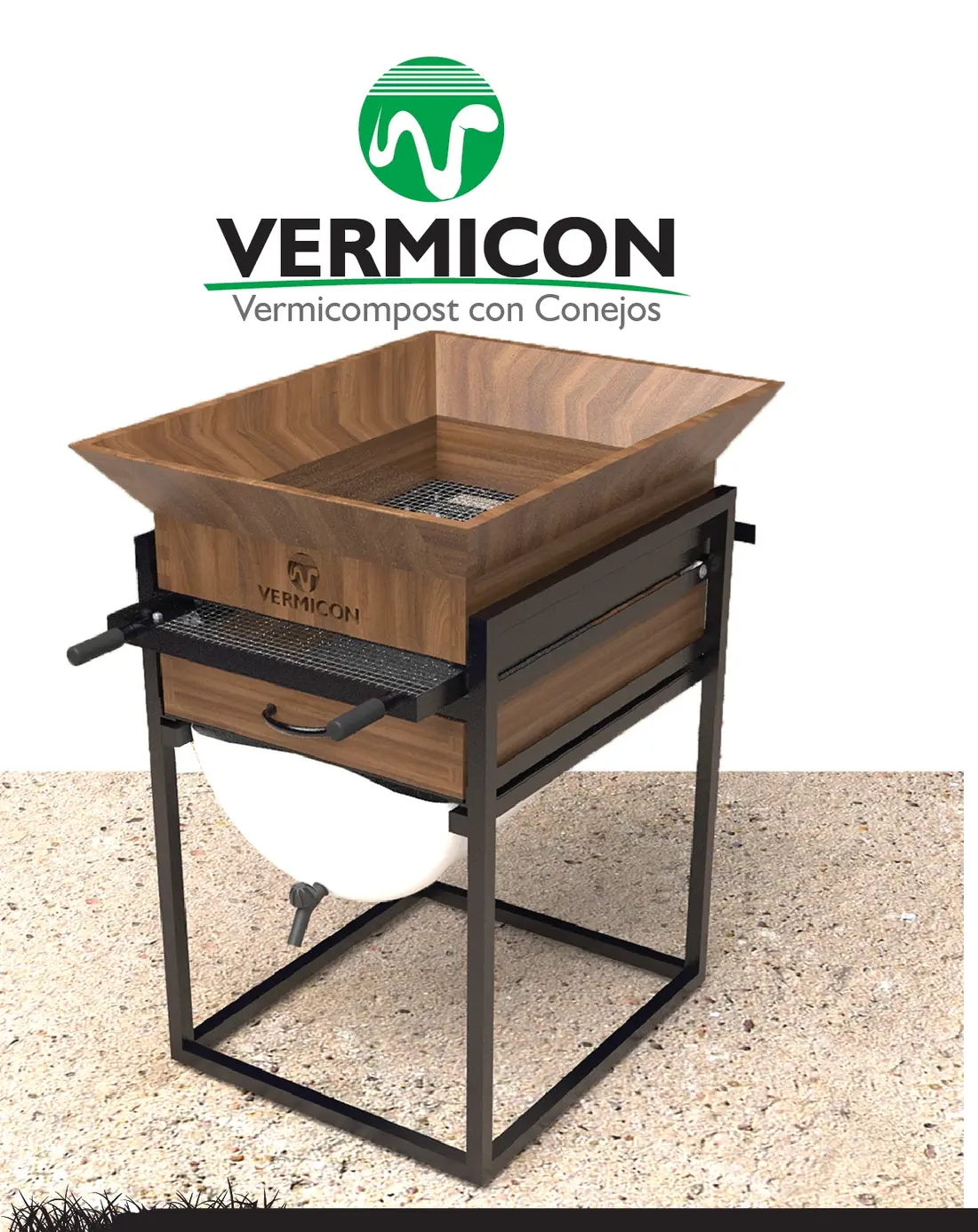
Designing a system that turns rabbit-farm waste into useful resources.
Vermicon was developed in 2013 as an Industrial Design professional practice project at EUCD. It proposes a semi-automatic device for producing vermicompost, collecting liquid fertilizer, and separating worms.
Rather than working as an isolated container, the concept organizes a complete process: it receives the manure, supports vermiculture, separates the material, and helps obtain three outputs within the same piece of equipment.
The images and technical documentation retain their original 2013 visual language and Spanish labels. This portfolio edition reorganizes the story, but does not redesign the project or claim outcomes that were not measured.
Using a waste stream already available within the productive system.
The starting point was manure generated by rabbit hutches and the opportunity to return it to the site through vermiculture.
The project aimed to reduce handling between stages and prevent collection, processing, and separation from becoming disconnected tasks. The device was conceived to work below rabbit hutches of different sizes by adapting mainly its upper hopper.
- Manure collection
- Vermiculture inside the device
- Sieving and separation
- Use of the resulting resources
Project description
Vermicon is a device designed to produce vermicompost, liquid fertilizer, and earthworms. Vermicompost is a natural fertilizer obtained by processing rabbit manure through vermiculture. The collected liquid, referred to as worm tea in the original documentation, can be diluted in water and used as a foliar fertilizer.
As an additional benefit, the system makes use of earthworm reproduction. New populations can be introduced into other devices, used as poultry feed, or sold as a separate product.
The device organizes a continuous, semi-automatic sequence, from manure collection to the separation of the final outputs. A sliding sieve filters the vermicompost, produces finer granules, and helps prevent the loss of earthworms.
- Vermicompost as a solid fertilizer.
- Liquid fertilizer for foliar application.
- Earthworms for other devices, poultry feed, or sale.
The semi-closed cycle is based on reusing waste generated on the farm. The initial earthworm population is the only planned external input. Vermicon can work with rabbit hutches of different sizes by adapting mainly its upper hopper.
The proposal aimed to reduce manual work, minimize waste from rabbit production, create complementary outputs, and limit the use of external inputs within an agroecological and sustainable design approach.
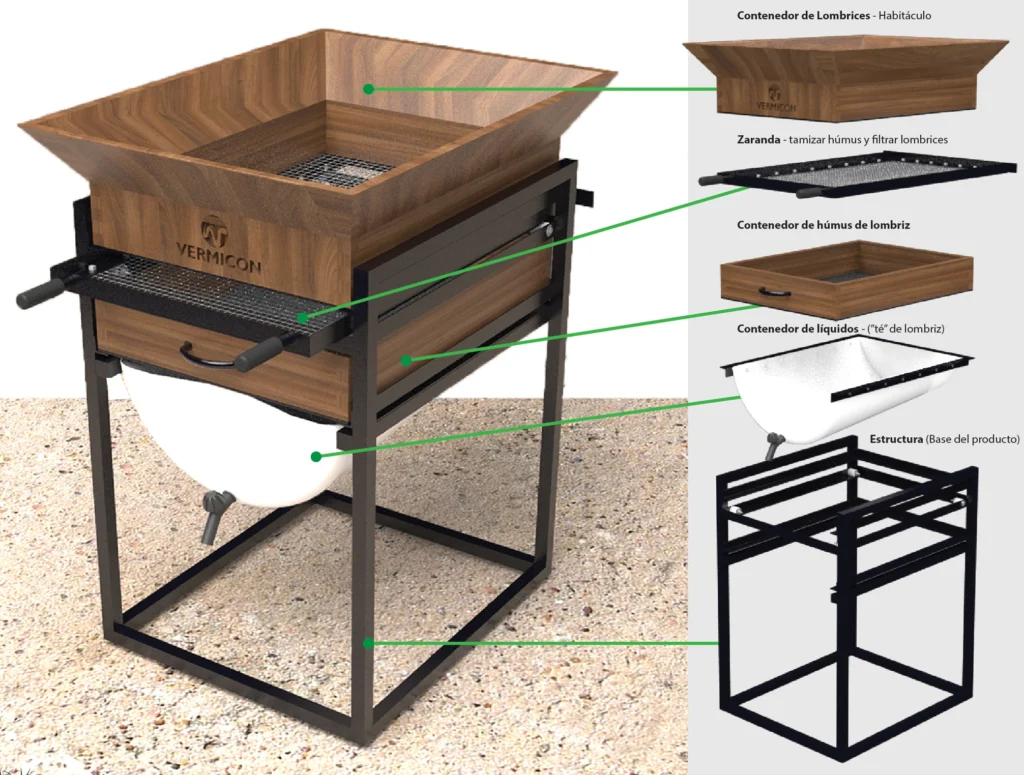
Five coordinated assemblies for containing, filtering, collecting, and supporting.
The product architecture was organized through independent components that could be manufactured, maintained, and used as parts of one system.
- Upper container or habitat for worms and organic material.
- Sliding sieve for filtering vermicompost and separating worms.
- Collection drawer for the solid fertilizer.
- Lower container for the collected liquid, described as worm tea in the original documentation.
- Metal frame that supports and connects the full assembly.
One waste stream could become three useful resources.
- Vermicompost, used as a solid fertilizer.
- Liquid fertilizer intended for diluted application.
- Worms for starting other devices, feeding poultry, or selling.
The value of the concept was its semi-closed cycle. Waste generated on site returned to the productive system, while the initial worm population was the main external input. The proposal sought to organize the process and reduce handling, without claiming metrics that were not documented.
The project progressed from system architecture to manufacturing detail.
Documentation included exploded views, component tables, functions, materials, processes, finishes, quantities, and dimensioned drawings.
The resolution combined timber components for the containers, steel profiles and flat bars for the structure, metal meshes for supporting and sieving, plus hardware and handles. Each assembly was defined according to its role in the material flow.
The product experience also included identity, instructions, and brand application.
The development did not end with the object. Vermicon included a visual system, identifier variants, color and reduction criteria, a user manual, and direct brand application on the timber. Communication helped explain an unconventional product and give it a recognizable identity.
The system explained in motion.
The original video documents the use logic and the relationship between the product components.
An early project that still explains how I understand product design.
Reflection
The object was the visible part of a larger system.
Although its visual representation belongs to an earlier stage of my training, Vermicon already worked with relationships that remain present in my practice today: inputs and outputs, use sequences, components, manufacturing, maintenance, productive context, and communication. It is an early example of a design approach that begins by understanding the system and then defines the product.
The original project publication remains available on Behance.